Creative Stonesetting by Cogswell John
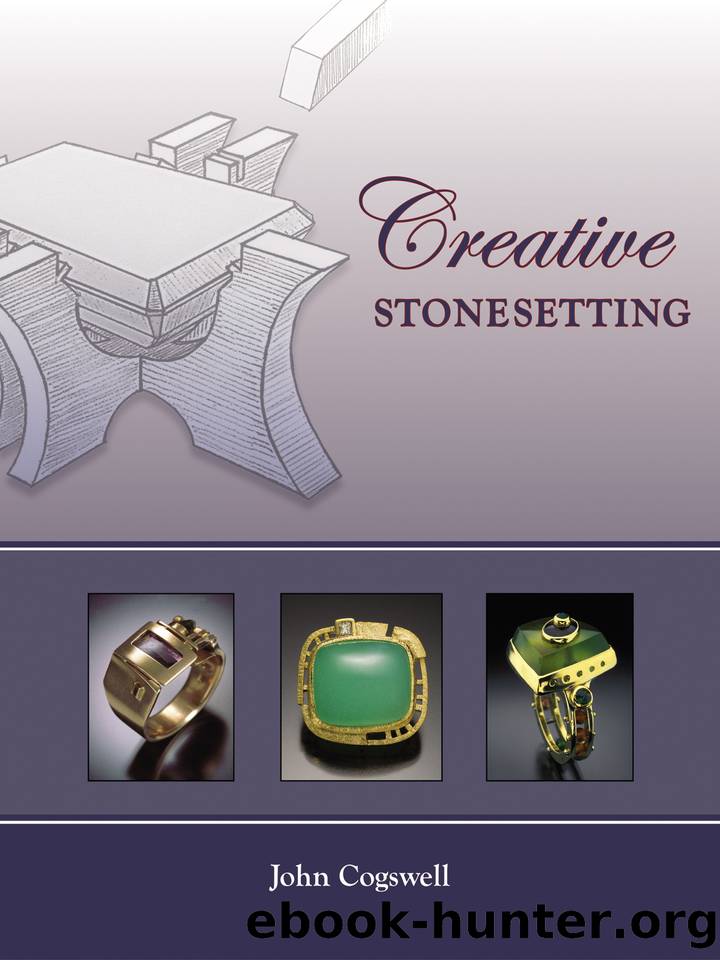
Author:Cogswell, John [Cogswell, John]
Language: eng
Format: epub
Publisher: Brynmorgen Press
Published: 2018-03-11T16:00:00+00:00
Sequence for Cutting a Seat with Files
1.
Mark the places where the stone touches each prong ,
2.
Uuse a round needle file to cut notches below these points .
3.
Cut away the metal above the notch to prepare the prong to be pressed against the stone .
Cutting a Seat with a Bur
Using a bur to cut a seat has several advantages. The process is much faster than using a graver or needle files, and, especially in the case of small settings, the bur can fit into tight spaces with relative ease. There are, however, a number of limitations. A set of good stonesetting burs is expensive and requires a flexible shaft machine. Because burs rotate in a circular path, they only cut circular seats. Though fine for round stones, they are of little use when cutting seats for other shapes. Burs can also cut too efficiently—they can cut too deep and too far, even cutting prong tips off. The bottom line: even though burs are faster and simpler to use than gravers, their proper use still requires practice, a steady hand, and constant monitoring.
Setting Burs
There are several families of specialized burs that are used for setting stones. Of these, Hart burs and stonesetting burs are most common. Hart burs have a sharp, angular profile, tapering conically on either side of the cutting edge. Hart burs are available with 45º or 90º cutting edges, the choice of which to use usually depends on the shape of the stone and individual preference. Stonesetting burs have vertical sides above a conical tip that mimics the silhouette of the pavilion of a round, brilliant-cut stone. Standard stonesetting burs are designed to cut straight down into a setting, in line with the axis of the bur’s shaft. They are less inclined to wander and are easier to control. For most prong settings, and especially for beginners, stonesetting burs are probably the best tool for the job. Some stonesetting burs are designed with a built-in depth control that limits the depth to which the bur can cut. This may be helpful for commercial settings, but it limits the use of these burs in other situations on hand-fabricated settings. I prefer plain setting burs that allow me to control the depth and angle of a cut.
Download
This site does not store any files on its server. We only index and link to content provided by other sites. Please contact the content providers to delete copyright contents if any and email us, we'll remove relevant links or contents immediately.
The Great Music City by Andrea Baker(34072)
Aircraft Design of WWII: A Sketchbook by Lockheed Aircraft Corporation(32392)
Call Me by Your Name by André Aciman(20757)
The Secret History by Donna Tartt(19514)
The Art of Boudoir Photography: How to Create Stunning Photographs of Women by Christa Meola(18789)
Shoot Sexy by Ryan Armbrust(17873)
Plagued by Fire by Paul Hendrickson(17557)
Portrait Mastery in Black & White: Learn the Signature Style of a Legendary Photographer by Tim Kelly(17116)
Adobe Camera Raw For Digital Photographers Only by Rob Sheppard(17109)
Photographically Speaking: A Deeper Look at Creating Stronger Images (Eva Spring's Library) by David duChemin(16811)
Ready Player One by Cline Ernest(15176)
Pimp by Iceberg Slim(14822)
Bombshells: Glamour Girls of a Lifetime by Sullivan Steve(14242)
The Goal (Off-Campus #4) by Elle Kennedy(13996)
Art Nude Photography Explained: How to Photograph and Understand Great Art Nude Images by Simon Walden(13161)
Kathy Andrews Collection by Kathy Andrews(12126)
The Priory of the Orange Tree by Samantha Shannon(9398)
The remains of the day by Kazuo Ishiguro(9251)
Thirteen Reasons Why by Jay Asher(9155)
